Pray
Jana Gana Mana Adhinayaka, Jaya He
Bharata Bhagya Vidhata
Punjab Sindhu Gujarata Maratha
Dravida Utkala Banga (places in India)
Vindhya Himachala Yamuna Ganga
Uchchhala Jaladhi Taranga
Tava Shubha Name Jage
Tava Shubha Ashisha Mage
Gahe Tava Jaya Gaatha
Jana Gana Mangaladayaka Jaya He
Bharata Bhaagya Vidhata
Jaya He ! Jaya He ! Jaya He !
Jaya, Jaya, Jaya, Jaya He
Monday, August 4, 2008

India's First War of Independence
 The First War of Indian Independence is a term predominantly used in India to describe the Indian Rebellion of 1857, which has been described variously as "uprising", "revolt" and "mutiny"
History
The Indian Rebellion of 1857 is now recognized as developing into more than just a mutiny. However due to the manner in which it started the name Sepoy Mutiny became the standard name for events, a convention which stuck for over 100 years. Contemporary anti-imperialists viewed this term as propaganda, and pushed to characterize it as more that just the actions of a few mutinous native soldiers. Karl Marx was the first Western scholar to call the 1857 revolt a "national revolt", though he used the term "Sepoy Revolt" to describe the event.In India, the term "First War of Independence" was first popularized by Vinayak Damodar Savarkar in his book The History of the War of Indian Independence, which was originally written in Marathi
Jawaharlal Nehru, the first Prime Minister of India, insisted on using the term "First War of Independence" to refer to the event, and the terminology was adopted by the Government of IndiaIndependence Day Video
Happy independence day to India
Sare Jahan Se Achaa(Choir)
Indian Patriotic Song -- Apni Azadi Ko Hum -- Mohammad Rafi
Kar Chale Hum Fida - Mohd Rafi Saab - Dedicated To India
Zindagi Maut Na Ban jaye
Sare Jahan Se Achaa(Choir)
Indian Patriotic Song -- Apni Azadi Ko Hum -- Mohammad Rafi
Kar Chale Hum Fida - Mohd Rafi Saab - Dedicated To India
Zindagi Maut Na Ban jaye
Celebrations
Red Fort, Delhi, On August 15th.

15th August is a National holiday of India. In the capital New Delhi most of the Government Offices are lit up. Flag hoisting ceremonies and cultural programs take place in all the state capitals. In the cities around the country the Flag Hoisting Ceremony is done by politicians belonging to that constituency. In various private organisations the Flag Hoisting Ceremony is carried out by a Senior officer of that organisation. Schools and colleges around the country organise flag hoisting ceremony and various cultural activities within their respective premises. Families and friends get together for lunch or dinner, or for an outing. Housing colonies, cultural centres, clubs and societies hold entertainment programmes and competitions, usually based on the freedom theme.
15th August is a National holiday of India. In the capital New Delhi most of the Government Offices are lit up. Flag hoisting ceremonies and cultural programs take place in all the state capitals. In the cities around the country the Flag Hoisting Ceremony is done by politicians belonging to that constituency. In various private organisations the Flag Hoisting Ceremony is carried out by a Senior officer of that organisation. Schools and colleges around the country organise flag hoisting ceremony and various cultural activities within their respective premises. Families and friends get together for lunch or dinner, or for an outing. Housing colonies, cultural centres, clubs and societies hold entertainment programmes and competitions, usually based on the freedom theme.
History
Jawaharlal Nehru's tryst with destiny speech

3 June 1947, Viscount Lord Louis Mountbatten, the last British Governor-General of India, announced the partitioning of the British Indian Empire into India and Pakistan, under the provisions of the Indian Independence Act 1947. At the stroke of midnight, on 15 August 1947, India became an independent nation. This was preceded by Pandit Jawaharlal Nehru's famous speech titled Tryst with destiny.
3 June 1947, Viscount Lord Louis Mountbatten, the last British Governor-General of India, announced the partitioning of the British Indian Empire into India and Pakistan, under the provisions of the Indian Independence Act 1947. At the stroke of midnight, on 15 August 1947, India became an independent nation. This was preceded by Pandit Jawaharlal Nehru's famous speech titled Tryst with destiny.
| “ | At the stroke of the midnight hour, when the world sleeps, India will awake to life and freedom. A moment comes, which comes but rarely in history, when we step out from the old to the new, when an age ends, and when the soul of a nation, long suppressed, finds utterance..... We end today a period of ill fortune, and India discovers herself again. | ” |
Prime Minister Nehru and Deputy Prime Minister Sardar Vallabhbhai Patel invited Lord Mountbatten to continue as Governor General of India. He was replaced in June 1948 by Chakravarti Rajagopalachari. Patel took on the responsibility of unifying 565 princely states, steering efforts by his “iron fist in a velvet glove” policies, exemplified by the use of military force to integrate Junagadh, Jammu and Kashmir, and Hyderabad state into India. J&K became a part of India when Pakistan laid siege and the then king Maharaja Hari Singh signed the Instrument of Accession with India to save J&K from Pakistan. India responded on behalf of J&K by sending in its armed forces to counteract the Pakistani attack. Later PM Nehru went to UN and a cease fire was declared. Pakistan has not withdrawn its military forces from the occupied Kashmir, and the territory termed as POK (Pakistan Occupied Kashmir) has ever since been a cause of contention between India and Pakistan.
The Constituent Assembly completed the work of drafting the constitution on 26 November 1949; on 26 January 1950 the Republic of India was officially proclaimed. The Constituent Assembly elected Dr. Rajendra Prasad as the first President of India, taking over from Governor General Rajgopalachari. Subsequently, a free and sovereign India absorbed two other territories: Goa (liberated from Portuguese control in 1961) and Pondicherry (which the French ceded in 1954). In 1952, India held its first general elections, with a voter turnout exceeding 62%; in practice, this made India the world's largest democratic country in the history of the modern and ancient world.
Mahatma Gandhi also played a huge role in the gaining of independence.
Independence Day (India)
India's Independence Day
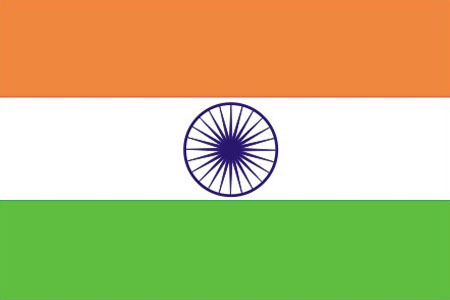 (Hindi: स्वतंत्रता दिवस) is celebrated on August 15 to commemorate its independence from the British rule and its birth as a sovereign nation on that day in 1947. The day is a national holiday in India. It is celebrated all over the country through flag-hoisting ceremony and distribution of sweets. The main celebration takes place in New Delhi, where the Prime Minister hoists the National Flag at the Red Fort and delivers a nationally televised speech from its ramparts. In his speech, he highlights the achievements of his government during the past year, raises important issues and gives a call for further development. The Prime Minister also pays his tribute to leaders of the freedom struggle.
(Hindi: स्वतंत्रता दिवस) is celebrated on August 15 to commemorate its independence from the British rule and its birth as a sovereign nation on that day in 1947. The day is a national holiday in India. It is celebrated all over the country through flag-hoisting ceremony and distribution of sweets. The main celebration takes place in New Delhi, where the Prime Minister hoists the National Flag at the Red Fort and delivers a nationally televised speech from its ramparts. In his speech, he highlights the achievements of his government during the past year, raises important issues and gives a call for further development. The Prime Minister also pays his tribute to leaders of the freedom struggle.
Subscribe to:
Posts (Atom)